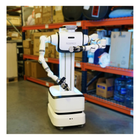
- Wheeled humanoid that travels between stations Its own navigation set of LiDAR, RGB and depth cameras and an IMU lets one robot serve several work areas instead of fixing it to one.
- Two arms at 11 lb each The rating applies per arm, so object weight, grip method and tooling all need reviewing against it for a given task.
- Four task cameras Two depth units and two arm-mounted cameras feed object recognition and obstacle detection during manipulation.
- NVIDIA Jetson Thor onboard The compute sits on the robot, which is what the manufacturer's perception and decision-making claims rest on.
- Floor traversal limits Gaps up to 1.5 in, ridges up to 0.7 in and ADA ramp compliance give concrete thresholds to survey a route against.
- Four hours per charge, two to recharge That ratio is the planning figure for shift coverage, and it is specific to the mobile configuration.
- Modular end effectors and over-the-air updates Tooling swaps to suit a job rather than requiring a rebuilt cell, and Richtech states that software capability grows after delivery.

Description
Dex Mobile is a pre-launch platform. It is approaching commercial release, so the figures below are pre-launch specifications that may change before general availability.
It is the wheeled configuration of Richtech's Dex industrial humanoid: 4 ft 6 in tall, two arms rated at 11 lb each, four task cameras (two depth units and two mounted on the arms), an NVIDIA Jetson Thor onboard computer, and about four hours of battery with a two-hour recharge. Navigation is its own sensor set — LiDAR, an RGB camera, a depth camera and an IMU — so the robot travels between work areas rather than waiting for work to arrive.
The traversal limits give planners something concrete to measure against: floor gaps up to 1.5 in, ridges up to 0.7 in and ADA ramp compliance. Expansion joints, dock plates and ramps along the intended route can be checked against those numbers before anything is ordered, and the four-hour battery with a two-hour charge sets the shift pattern.
The difference from Dex Stationary is mobility and power. Dex Stationary stands 3 ft 7 in on a fixed base with continuous power and no battery or navigation specification at all; Dex Mobile carries its own battery and navigation suite so one robot can serve several stations. Both share the 11 lb per-arm rating, the four-camera task vision, the Jetson Thor computer, modular end effectors and Richtech's simulation-to-real training approach.
Key Capabilities
- Wheeled humanoid that travels between stations: Its own navigation set of LiDAR, RGB and depth cameras and an IMU lets one robot serve several work areas instead of fixing it to one.
- Two arms at 11 lb each: The rating applies per arm, so object weight, grip method and tooling all need reviewing against it for a given task.
- Four task cameras: Two depth units and two arm-mounted cameras feed object recognition and obstacle detection during manipulation.
- NVIDIA Jetson Thor onboard: The compute sits on the robot, which is what the manufacturer's perception and decision-making claims rest on.
- Floor traversal limits: Gaps up to 1.5 in, ridges up to 0.7 in and ADA ramp compliance give concrete thresholds to survey a route against.
- Four hours per charge, two to recharge: That ratio is the planning figure for shift coverage, and it is specific to the mobile configuration.
- Modular end effectors and over-the-air updates: Tooling swaps to suit a job rather than requiring a rebuilt cell, and Richtech states that software capability grows after delivery.
This model is offered on a quotation basis. Configuration, accessories, integration scope and delivery schedule all change the final figure, so pricing is confirmed per project rather than listed.
Buying through Robotix Market
This unit is sourced new through established distribution channels and ships worldwide with the manufacturer warranty. Technical support is coordinated with the manufacturer's own service network. Deployment scope, configuration, and commissioning responsibilities are agreed as part of the quotation — on-site installation is not included in the product price.
Features
Specs
| Brand | Richtech |
|---|---|
| Manufacturer | Richtech Robotics |
| Model | Dex Mobile |
| Product Type | Industrial humanoid, wheeled mobile configuration |
| Status | Pre-launch; specifications may change before general availability |
| Height | 4 ft 6 in (approx. 137.2 cm) |
| Payload Capacity | 11 lb per arm |
| Task Vision System | 4 cameras (2 depth, 2 arm-mounted) |
| Autonomous Navigation | LiDAR, RGB camera, depth camera, IMU |
| Onboard Computer | NVIDIA Jetson Thor |
| Battery Life | Approx. 4 hours |
| Charging Time | Approx. 2 hours |
| Maximum Floor Gap | 1.5 in |
| Maximum Ridge Traverse | 0.7 in |
| ADA Ramp Compliant | Yes, per the manufacturer |
| End Effectors | Modular, swappable per job |
| Training Method | Simulation training refined in real-world testing |
| Software Updates | Over-the-air, per the manufacturer |
| Weight | Confirm at quote |
| Reach | Confirm at quote |
| Price | Quotation only |
Industries
Frequently Asked Questions
Not as a shipping product. Richtech describes Dex as approaching launch and is sharing specifications and roadmap updates with interested parties, so a quotation request is the way to register interest and be told when ordering opens.
The mobile configuration carries LiDAR, an RGB camera, a depth camera and an IMU, which Richtech says lets it cross changing spaces rather than follow fixed paths. Its traversal limits are floor gaps up to 1.5 inches, ridges up to 0.7 inches and ADA ramp compliance.
Each arm is rated for 11 lb. That is a per-arm figure, so object weight, grip method and tooling choice all need checking against it, and anything beyond it confirmed with the manufacturer.
Mobility and power. Dex Mobile is 4 feet 6 inches tall on a wheeled base with a four-hour battery and its own navigation sensors. Dex Stationary is 3 feet 7 inches on a fixed base running on continuous power, with no battery or navigation specification.
Richtech describes skills being developed in simulation and then refined through physical testing. Combined with modular end effectors and over-the-air updates, the intent is that varied jobs can be taken on without rebuilding the cell.
It is offered by quotation — and because the platform is pre-launch, configuration, tooling and timing are all confirmed per project as the manufacturer moves toward release.
Recently Viewed
You haven't viewed any products yet.