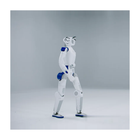
- 24 active degrees of freedom Five per arm, two at the waist and six per leg, with no active head joint, on a body of about 39 kg with end effectors and battery.
- Motion-control head as standard The base version carries no standard visual sensor, so perception hardware is chosen and fitted to suit the project.
- Dummy hands fitted as delivered The wrist architecture also takes dexterous hands or grippers, and optional dexterous configurations come with 6 or 22 DOF.
- RK3588 base computing Development computing is optional, and the specific module is chosen in the configuration discussion.
- Hot-swappable dual battery A large-and-small pack arrangement allows a battery change without shutting the robot down, with about three hours per charge.
- Open hardware and software stack Drawings, bills of materials, PCB information, 3D models, motor drivers, gait algorithms, ROS 2 middleware, an SDK, simulation and training code are all published.
- Enclosed joints and redundant stops RoboParty describes fully enclosed joints to reduce pinch exposure plus remote and wearable emergency stops with three-channel redundancy.

Description
The RoboParty RP1 is the base version of the ROBOTO 01 open humanoid development platform, built for researchers and independent developers who need the hardware and the software stack rather than a sealed demonstration robot. It has 24 active degrees of freedom: five per arm, two at the waist, six per leg, and no active head joint. It weighs about 39 kg with end effectors and battery.
What the standard RP1 ships with is deliberately plain. The head is the motion-control configuration, the end effectors are dummy hands, there is no standard visual sensor, and base computing is an RK3588; development computing is optional, with the module chosen in the configuration. It carries a six-axis IMU. That makes it the version to pick when the host project supplies its own perception, hands and compute, rather than paying for equipment it will replace.
Both ROBOTO 01 variants stand 1.35 m, with standing dimensions of 1350 x 450 x 200 mm, a 250 mm thigh, a 300 mm calf and a 550 mm single-arm length in AL6061/7075 aluminium alloy, engineering plastics and rubber. Motion figures are shared too: up to 4 m/s, a 30 degree climbing capability, a 50 mm maximum step and a 3 kg payload, with its split between arms and hands confirmed with the quotation. Power is a 10 Ah pack rated for three hours with a 1.5 hour charge, in a large-and-small dual-battery arrangement that allows a swap without shutting down, over USB-C or magnetic charging and with operation while charging supported.
The open-development material is the reason to choose this platform over a closed demonstrator: module and body drawings, bills of materials, interface definitions, PCB information and 3D models on the hardware side; motor drivers, gait algorithms, perception and decision models, ROS 2 middleware, an SDK, simulation environments and training code on the software side. Which repository release is current, and how complete each resource is, is worth checking before planning an implementation.
Key Capabilities
- 24 active degrees of freedom: Five per arm, two at the waist and six per leg, with no active head joint, on a body of about 39 kg with end effectors and battery.
- Motion-control head as standard: The base version carries no standard visual sensor, so perception hardware is chosen and fitted to suit the project.
- Dummy hands fitted as delivered: The wrist architecture also takes dexterous hands or grippers, and optional dexterous configurations come with 6 or 22 DOF.
- RK3588 base computing: Development computing is optional, and the specific module is chosen in the configuration discussion.
- Hot-swappable dual battery: A large-and-small pack arrangement allows a battery change without shutting the robot down, with about three hours per charge.
- Open hardware and software stack: Drawings, bills of materials, PCB information, 3D models, motor drivers, gait algorithms, ROS 2 middleware, an SDK, simulation and training code are all published.
- Enclosed joints and redundant stops: RoboParty describes fully enclosed joints to reduce pinch exposure plus remote and wearable emergency stops with three-channel redundancy.
This model is offered on a quotation basis. Configuration, accessories, integration scope and delivery schedule all change the final figure, so pricing is confirmed per project rather than listed.
Buying through Robotix Market
This unit is sourced new through established distribution channels and ships worldwide with the manufacturer warranty. Technical support is coordinated with the manufacturer's own service network. Deployment scope, configuration, and commissioning responsibilities are agreed as part of the quotation — on-site installation is not included in the product price.
Features
Specs
| Brand | RoboParty |
|---|---|
| Manufacturer | RoboParty |
| Model | ROBOTO 01 (RP1) |
| Product Type | Open humanoid robot development platform |
| Active Degrees of Freedom | 24 (5 per arm, 2 waist, 6 per leg; no active head joint) |
| Mass | Approx. 39 kg with end effectors and battery |
| Height | 1.35 m |
| Standing Dimensions | 1350 x 450 x 200 mm (height x body width x body depth) |
| Limb Lengths | Thigh 250 mm, calf 300 mm, single arm 550 mm |
| Body Materials | AL6061/7075 aluminium alloy, engineering plastics, special rubber |
| Maximum Running Speed | Up to 4 m/s |
| Climbing Capability | 30 degrees |
| Maximum Step Crossing | 50 mm |
| Obstacle Avoidance Minimum Size | 50 mm |
| Payload | 3 kg (split between arms and hands confirmed with the quotation) |
| Joint Modules | Four in-house designs, two-stage planetary with inner-rotor structure |
| Peak Torque | 160 N·m, associated with the 100 mm outer-diameter module only |
| Battery | 10 Ah, approx. 3 hours runtime, 1.5 hour charge, dual-battery hot swap |
| Charging | USB-C and magnetic; operation while charging supported |
| Standard Head | Motion-control head |
| Standard End Effectors | Dummy hands |
| Standard Visual Sensor | None in the base configuration |
| Base Computing | RK3588 |
| Development Computing | Optional; module confirmed at quote |
| Inertial Sensing | High-precision six-axis IMU |
| Interaction Equipment | Speaker; remote-controller and app control |
| Connectivity | Wi-Fi 6, Bluetooth 5.2, 4G |
| Ports | 2x USB Type-A, 2x USB Type-C, 2x RJ45 |
| Optional Sensing | Intel D435i depth camera; perception head adds 3D LiDAR; data-collection head uses a binocular RGB camera |
| Optional Hands | Dexterous hands at 6 or 22 DOF, or grippers |
| End-Effector Wiring | 24 V, with provision for an adapter board |
| Operating Temperature | -10 to 40 degrees C |
| Safety Design | Enclosed joints, remote and wearable emergency stops, three-channel stop redundancy |
| Open Resources | Drawings, BOM, interfaces, PCB data, 3D models, drivers, gait algorithms, ROS 2, SDK, simulation, training code |
| Charging Power Rating | Confirm at quote |
| Price | Quotation only |
Industries
Frequently Asked Questions
It is the base variant of RoboParty's open ROBOTO 01 humanoid development platform, with 24 active degrees of freedom and published hardware and software development resources for researchers and independent developers.
The RP1 has 24 active degrees of freedom and about 39 kg of mass, a motion-control head with no standard visual sensor, dummy hands and RK3588 base computing. The Pro has 30 degrees of freedom including two at the head, about 41 kg, an interaction head with a monocular RGB camera, 6-DOF dexterous hands as standard and an added Orin NX development computer.
Not in the base configuration. The Intel D435i depth camera is an option, and the combined depth-camera and 3D LiDAR arrangement belongs to the perception-head configuration, which has to be selected.
The payload is 3 kg. How that load divides between the arms or hands is confirmed with the quotation, so it should not be read as a per-hand lifting rating.
Module and body drawings, bills of materials, interface definitions, PCB information and 3D models on the hardware side; motor drivers, gait algorithms, perception and decision models, ROS 2 middleware, an SDK, simulation environments and training code on the software side.
It is offered by quotation — the version, supplied hands, sensors, computing modules, battery equipment and documentation revision all shape the configuration and are confirmed per project.
Recently Viewed
You haven't viewed any products yet.